Krach Institute for Tech Diplomacy at Purdue Launches the World’s First Global Trusted Tech Standard (xGTT) with the Backing of Dozens of Visionary Leaders
WASHINGTON, Nov. 13, 2026
Press Release Disclaimer: This is a press release distributed through the XPR Media network. It has not been independently verified by our newsroom.

Krach Institute for Tech Diplomacy at Purdue Launches the World’s First Global Trusted Tech Standard (xGTT) with the Backing of Dozens of Visionary Leaders
PR Newswire
WASHINGTON, Nov. 13, 2026
A free, open standard gives governments, businesses, universities and other decision-makers a common framework to assess whether companies operate in alignment with democratic values
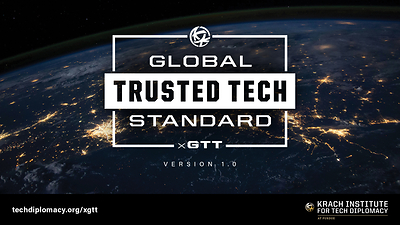
WASHINGTON, Nov. 13, 2026 /PRNewswire/ — The Krach Institute for Tech Diplomacy at Purdue today announced the launch of the Global Trusted Tech Standard (xGTT), the world’s first open standard for trusted technology. The principle behind xGTT is straightforward: trust must be earned through conduct. In democratic markets, companies earn trust by respecting the laws, rights, and principles that underpin free societies. The xGTT Standard provides governments, businesses, universities, and other institutions with a common, evidence-based framework for assessing whether a company has earned that trust.
Unlike standards that narrowly focus on technical performance, xGTT goes one step further, covering companies’ compatibility with democratic values, such as respect for the rule of law, human rights, intellectual property, transparency, accountability, and others. xGTT applies to 15 critical and emerging technology (CET) sectors that are central to economic competitiveness, national security, and democratic resilience. Its criteria draw on the laws, regulations, standards, and established practices of 18 technologically advanced democracies, providing a shared reference point grounded in multiple jurisdictions rather than the position of any single government.
|
15 CETs covered by xGTT |
18 Techno-Democracies Anchoring xGTT Criteria |
|
1. Advanced Communications & Networking |
1. Australia |
The Global Trusted Tech Standard (xGTT) was announced at the Krach Institute for Tech Diplomacy at Purdue’s 2026 Trusted Tech Summit, the premier forum for Tech Diplomancy. The annual Summit brings together U.S. and allied government officials, technology executives, investors, and strategic partners to address the alliances, standards, and strategies shaping trusted technology. The launch of xGTT advances that mission by providing a shared, evidence-based framework for assessing corporate trustworthiness across critical and emerging technology sectors.
“Technology will either serve humanity or be used to undermine it, and trust is a decisive factor. By grounding economic collaboration in democratic principles, the Global Trusted Tech Standard makes it easier to operate efficiently in the free world, giving companies that earn trust a real competitive advantage,” said Keith Krach, Chairman of the Krach Institute for Tech Diplomacy at Purdue. “Together, we can ensure tomorrow’s technology advances freedom for generations to come.”
“Trust is the free world’s superpower, and it is how we set the pace,” said Michelle Giuda, CEO of the Krach Institute. “The Global Trusted Tech Standard delivers a real-world definition of trusted technology. It’s simple, open, and free. Governments, companies, and universities can use it to guide procurement, supply chains, partnerships, and research, so collaboration moves faster and security and prosperity grow. That is how we win against those who weaponize technology against people.”
xGTT Board of Governors
The xGTT Standard is guided by a Board of Governors, comprising 20 distinguished international experts spanning government, industry, academia, and civil society across 9 countries:
- Audrey Tang, Chair of the xGTT Board; Taiwan’s Cyber Ambassador-at-Large
- Roberto Baldoni, former Deputy Director General of Italian Intelligence; founding Director General of Italy’s National Cybersecurity Agency (ACN)
- Isabel Cane, former Head of OECD Trust in Business and Blue Dot Network
- Alex Capri, Senior Fellow and Lecturer, NUS Business School in Singapore
- Dan DeLaurentis, Professor of Aeronautics and Astronautics and EVP for Research, Purdue University
- Mike Derrios, Executive Director, Greg and Camille Baroni Center for Government Contracting, George Mason University
- Rick Echevarria, Senior Vice President of Business Development, Keyfactor
- Obiageli “Oby” Ezekwesili, former Nigerian Minister of Education and of Minerals; former World Bank Vice President for Africa
- Fernando Garibay, GRAMMY® and BMI award-winning producer, songwriter, entrepreneur, author; Chairman and CEO, The Garibay Institute
- Melanie Garson, Associate Professor in International Security, University College London
- Dan Goldin, former Administrator, NASA
- Yasmin Green, CEO, Jigsaw
- Takashi Oda, Director of Business Strategy, NTT
- Roman Pačka, Chief Advisor to the Director of the Czech National Cyber and Information Security Agency (NÚKIB)
- Heather Petersen, former Head of Trust Strategy, DocuSign; former Executive Director, xDTM Standard Association
- David Roberts, Executive Director, Li-Bridge
- Harsh Shringla, Member of Parliament; former Indian Ambassador to the U.S.
- Tom Sonderman, CEO, SkyWater Technology
- Yigal Unna, former Director General, Israel’s National Cyber Directorate
- Ken Urquhart, Senior Fellow at the Krach Institute for Tech Diplomacy at Purdue
The Board reviews the criteria on a standing basis, so the xGTT Standard adapts as the underlying technologies, and the risks they carry, continue to evolve. xGTT is guided by people who understand how real-world technology decisions are made. Their experience helps keep it relevant to the people and institutions that will use it.
How xGTT Works
The xGTT Standard contains 31 criteria for assessing a company’s trustworthiness. These include 10 Red-Line Disqualifiers and 21 additional criteria covering Four Dimensions of Trust:
- Democratic Government Trust: Whether democratic governments have trusted the company enough to contract with it, vet it, or invest in it.
- Legal & Regulatory Compliance: Whether the company is free of serious misconduct findings by courts or governments that it has not remedied, such as corruption, fraud, repeated privacy violations, or intellectual property infringement.
- Transparency & Disclosures: Whether the company’s practices are open to independent verification, including audited financials, transparency about government requests for data, democratic supply chain practices, and published policies on corruption, human rights, and whistleblowers.
- Technical Security Practices: Whether the company protects and manages its technology responsibly, from cybersecurity and secure software development to privacy, responsible AI, export controls, environmental compliance, and operational resilience.
A confirmed Red-Line failure disqualifies a company and ends the evaluation. For all other criteria, each applicable criterion receives a verdict of PASS, FAIL, UNCLEAR, or N/A, depending on the available evidence and whether the criterion applies. xGTT does not produce a single overall score or rank companies against one another.
Who xGTT is Designed For
xGTT helps a broad range of leaders make faster, evidence-based decisions about the trustworthiness of companies they may buy from, invest in, or partner with. Its criteria cover both technological excellence and democratic values, and each user applies them under its own authority and for its own purposes:
- Governments and procurement authorities can integrate xGTT into procurement rules, requests for proposals (RFPs), and supply-chain vetting.
- Defense forces can integrate it into military RFPs, procurement rules, and vetting of dual-use supply chains.
- Enterprises and investors can apply it to enhance vendor due diligence, supply-chain risk assessment, and partnership decisions.
- Industry associations and manufacturers can use it to demonstrate supplier trustworthiness, strengthen integration into global value chains, and expand access to trusted international markets.
- Universities, research institutions, and standards bodies can use it as a reference for policy development, academic research, and coordination among like-minded institutions.
The xGTT Standard is for informational use only. It is not investment, legal, or financial advice, and xGTT evaluations do not constitute recommendations for or against any company, are not a regulatory finding or legal determination, and are not a substitute for independent due diligence. All decisions remain the responsibility of the organizations that use xGTT.
Government, Industry, and Civil Society Leaders Support the xGTT Standard
The Krach Institute already has endorsements from individuals all over the globe to include individuals from the Special Competitive Studies Project, Australian Strategic Policy Institute, Abba Eban Institute for Diplomacy and Foreign Relations, EDGE AI Foundation, Secure Economic Ecosystem, George Mason University’s Baroni Center for Government Contracting, Keyfactor, Leonardo US Corporation, Jigsaw, U.S.-Taiwan Business Council, Mahindra Group, ReElement Africa, ADASA Inc., SEMI Americas, Opportunity International, Guidehouse, and TalentCraft. The standard also has the backing of representatives from the governments of the Czech Republic, Estonia, India, Israel, Italy, Panama, Romania, Taiwan and Ukraine, reflecting a growing commitment among democratic partners to advance trusted technology grounded in shared values.
Bi-khim Hsiao, Vice President of Taiwan:
“As a champion of trusted technology, Taiwan is proud to support a brighter future driven by the synergy of human and super intelligence, anchored by the xGTT Standard.”
Luca Goretti, Chairman, Leonardo US Corporation:
“The Global Trusted Tech Standard (xGTT) builds trust by giving governments, companies, and partners a shared, verifiable benchmark for integrity, transparency, and security—reducing friction, enabling cross‑border collaboration, and accelerating the adoption of innovative technologies. If we all do not understand this simple statement and we do not work to implement it inside our regular and normal activities, within the institutions and industries, we have lost a great opportunity to build a strong and free society. We cannot afford to innovate only the technology, we have to innovate our mutual trust to be relevant…together!”
Yasmin Green, CEO, Jigsaw:
“At Jigsaw, we’ve learned that a secure internet requires not just new technology, but a new framework for trusted collaboration. The Global Trusted Tech Standard is that mechanism for enabling trusted partners to innovate together at speed and scale.”
Mohit Kapoor, Group Chief Technology Officer, Mahindra Group:
“As technology becomes increasingly central to businesses and societies, trust must become as important as innovation itself. A common and transparent framework for security, responsible governance and technology trust can help enterprises build stronger partnerships and more resilient digital ecosystems. xGTT is a welcome step in that direction.”
Audrey Tang, Taiwan’s Cyber Ambassador-at-Large and xGTT Board Chair:
“The Global Trusted Tech Standard represents a strong step forward for our free and open societies. In cultivating decentralised, secure ecosystems, the standard aligns with the Taiwan Model, which employs civic technology and radical transparency to build collective trust. For Taiwan, digital security is more than a defensive barrier. It is an essential democratic practice. Embracing the standard advances global resilience and safeguards our shared digital commons against authoritarians, as well as proves that democracy delivers a safer, more collaborative future for all.”
Eduardo Ortega-Barría, National Secretary for Science, Technology and Innovation, Panama:
“Panama commends the Krach Institute for Tech Diplomacy for building the Global Trusted Tech Standard, a framework that turns shared values into verifiable practice. We endorse this initiative because trusted technology is precisely the foundation on which Panama is building itself as Latin America’s trusted tech hub.”
Pavlo Frolov, Co-Chair, Trusted Tech Caucus, Ukrainian Parliament:
“Ukraine understands better than most how technology shapes security, economic growth, and the defense of freedom itself. Even as Ukrainians courageously defend our nation, we are working with our democratic allies to build a trusted technology ecosystem for the next generation. The Ukrainian Trusted Tech Caucus is proud to endorse the Global Trusted Tech Standard and commends the Krach Institute for Tech Diplomacy at Purdue for its leadership in accelerating the innovation and adoption of trusted technology.”
Roberto Baldoni, Founding Director General, Italy’s National Cybersecurity Agency (ACN):
“In today’s fragmented geopolitical landscape, democratic nations must align on the development and adoption of disruptive technologies to safeguard Western leadership. The Global Trusted Tech Standard, launched by the Krach Institute, serves as a platform to unite free nations around shared principles of trust, transparency, and security. By fostering collaboration among governments, industry, and innovators, it empowers the private sectors of allied democracies to work together and thrive, ensuring that technological progress reinforces the stability of the free world.”
Joe Stockunas, President, SEMI Americas:
“SEMI, the global trade association representing the semiconductor industry, recognizes the unprecedented pace of technological advancement shaping our sector. Ensuring these innovations are developed and deployed securely is essential to sustaining trust, resilience, and global collaboration. SEMI strongly endorses the Krach Institute’s Global Trusted Tech Standard as an important framework to help align technology development with democratic values and responsible practices. This initiative represents a meaningful step forward in fostering trusted, cross-border collaboration across the global technology ecosystem.”
Atul Tandon, CEO, Opportunity International:
“Trust has been the foundation of Opportunity International’s work for more than 55 years, and it must remain central as we embrace new technologies to expand opportunity and help families build stronger livelihoods and send their children to school. The Global Trusted Tech Standard provides an important framework for responsible innovation, ensuring technology serves people, protects their interests, and creates lasting impact.”
See additional endorsements at https://www.techdiplomacy.org/xgtt/home.
About the Krach Institute for Tech Diplomacy at Purdue
The Krach Institute is the world’s preeminent trusted technology accelerator. As the leader in the new category of Tech Diplomacy, the Institute integrates technology expertise, Silicon Valley strategies and foreign policy tools to build the Global Trusted Tech Network of governments, companies, organizations and individuals to accelerate the innovation and adoption of trusted technology and ensure technology advances freedom.
Visit the Krach Institute online at TechDiplomacy.org and follow on LinkedIn, X, Facebook, and YouTube. Learn more about the xGTT Standard at https://www.techdiplomacy.org/xgtt/home.
 View original content to download multimedia:https://www.prnewswire.com/news-releases/krach-institute-for-tech-diplomacy-at-purdue-launches-the-worlds-first-global-trusted-tech-standard-xgtt-with-the-backing-of-dozens-of-visionary-leaders-302939193.html
SOURCE The Krach Institute for Tech Diplomacy at Purdue